|
|
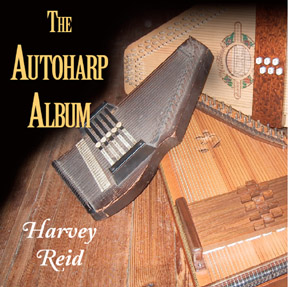
Reviews of "The Autoharp Album" by Harvey Reid
Bluegrass Breakdown (2003) by Dave Higgs
Many thanks for sending us a copy of the "The Autoharp Album" and "The
Artistry of the Six String Banjo," two of the most important CD's you've
ever recorded, in my opinion, because they've done so much to alert folks to the
beauty, subtlety and rich diversity of musical styles each instrument is capable
of projecting ... especially in the hands of a master such as yourself.
I've been playing tunes from the six string banjo collection ever since its release
back in '95. You've managed to coax an amazing number of sounds out of an instrument
that I, quite frankly, had heretofore written off. Your versions of "Bonaparte
Crossing the Rhine," "The Cuckoo," "Suite for the Duchess"
and others are just stunning. As is "The Autoharp Album," an aptly named
title for your latest masterpiece since, it is THE autoharp album. If anyone doubts
this instrument's depth, complexity, power and grandeur, this project will lay
all such skepticism to rest. I've never heard anything quite like it before -
in your hands the autoharp takes on old ballads, fiddle tunes, blues, ragtime,
gospel and even classically tinged tunes with equal aplomb, taste and class. I
especially enjoyed your takes on "Waltz of the Waves," "Down Yonder
Medley," "The Flower of Loudon County," "Frankie and Johnny"
and "Gathering the Harvest." It's truly not only a labor of love, but
a work of art as well; a seminal album that I hope will spur a revival of interest
in this often neglected instrument.
FACE Magazine by Dale
Robin Lochman
http://www.facemag.com/columns/index.php?article=135
Only a few people can make the autoharp sound orchestral, and York, Maine musician
Harvey Reid is at the top of that list. The autoharp is one of those instruments
that is at once fascinating and annoying. In the 1950s and ‘60s, a lot
of elementary school teachers had them in their classrooms. They are easy to
get a sound out of— you just press down the felt pads and you have a chord.
Most songs that a teacher might want to teach you would have three chords. So,
three buttons to push and you can play the autoharp, right? Well, no. So most
Americans’ first introduction to this unlikely instrument was not all too
pleasant.
In the late 1800s there was a craze of sorts—a proliferation of invented
instruments, many of which had gimmick-y methods of making sound. From the pianolin
to the autoharp, they were sold in catalogues and storefronts by the thousands.
The autoharp was a novelty item, and was sold as such. But in the Appalachians,
where modern American folk music was so strongly influenced, autoharps were
incorporated into the music right along with the older traditional instrumentation,
and made popular in a more seriously musical vein by the likes of “Pop”
Stoneman and Kilby Snow, and eventually the Carter Family, Mike Seeger and Bryan
Bowers.
Harvey Reid takes the autoharp seriously, as well, and has produced and performed
an unexpected masterpiece in The Autoharp Album (2003 Woodpecker Records WP117CD).
He has applied his characteristic attention to minute detail to the playing
of the autoharp and coaxes a vituoso sound from the instrument. What results
is a beautifully melodic and emotive recording that is wonderful listening.
He transcends the muddiness that the autoharp can often render with a crisp
chording technique and uncommon accuracy in plucking melodies within the chord.
To make the recording, Reid borrowed a variety of instruments from players all
over the country, so the sound of the CD is correspondingly varied. From Civil
War tunes to waltzes, from a hauntingly sad original to a Jimmy Rodgers song,
Reid has gathered a truly eclectic collection and captured the wide range of
sound and feeling just right.
Standing out for its just-plain-fun sound, “Peach Picking Time” by
Jimmy Rodgers is a surprise on the autoharp for the number of chord changes
it must involve! Reid picks up the frolicking mood of a trio of old time tunes
in his “Down Yonder Medley” of “Yonder,” “The Old Spinning
Wheel,” and “Redwing.” And plays the blues classic “Frankie
and Johnny” with some chords that would surprise even an autoharp player.
“Maplewood March” is a Reid-penned tune named for the avenue in Portsmouth
where he used to live; it has a perfect New England Country Dance feel to it.
The medley of “Southwind” and “Simple Gifts” has a pensive
and warm tone, as do the several hymns Reid recorded for this work.
The CD ends with “Let Your Light Shine on Me,” a traditional hymn
played on an autoharp made in the 1880s by the original maker of autoharps,
Charles Zimmerman. And this piece sounds just as old as that. A good way to
end an album, with the reminder of the richness of American musical history
contained therein.
Recording an entire CD of autoharp is an artistically spunky thing to have done,
and it works like magic. With just a few guitar, vocal and fiddle embellishments
in well-chosen places, the autoharp (along with its player) really remains the
star of this recording throughout.
Sing Out (Nov 2003) by MD
This is Reid's first album to solely feature his mastery of, and ingenuity with,
this uniquely American instrument. From the Carter Family to Kilby Snow, to his
own sparkling instrumentals, Reid plays a wide range of music here, accompanied
ably by David Surette on guitar and Joyce Anderson on fiddle. A must-have for
Autoharp players, and a real jot to listen to for all! (MD)
Portsmouth Herald (June 2003) by Chuck Ginsburg
Harvey Reid’s "The Autoharp Album" is sublime. It challenges
the virtuosity of Reid’s 17 or so other albums not just because an autoharp
album is still rare but because the musicianship and production, soup to nuts,
are so exquisite.
Devotees like Bryan Bowers and Reid are part of the instrument’s recent
resurgence, and Reid’s contributions to the repertoire can only add to
its popularity.
The autoharp, Reid tells us, is the only surviving member of many mechanical
zithers that appeared in the late 1800s. Originally of central-European origin,
the zither is struck or plucked. "The New Shorter Oxford Dictionary"
describes it as having four or five melody strings over a fretboard, with 30
to 40 accompanying strings, all running the length of a flat, shallow resonator
box.
We confess to being an unrepentant admirer of the Maine iconoclast’s talents,
but we have listened repeatedly, and futilely, for that one weak link amid 73-plus
musical minutes.
Flaws aren’t apparent, from the beguiling Reid instrumental, "Waltz
of the Waves," redolent with the ocean, through the Carter Family’s
"On the Sea of Galilee" and Reid’s evocative "The Coming
of Winter," to the album’s glorious gospel coda, the familiar "Let
Your Light Shine on Me."
Maybe you would prefer the re-recording of Reid’s "The Flower of Loudoun
County" or David Franey’s "The Flowers of Saskatchewan."
Favorites abound.
Reid ranges far and wide for material, tapping first his fertile imagination
and then mining Appalachia, ragtime, polka, blues and the folk heritage of Ireland,
Scotland and Norway.
Nine of 21 selections are Reid originals, with four tunes brand-new. Among the
others, traditionals predominate. Only Jimmie Rodgers, "America’s
Blue Yodeler" of the early 1900s, and Canadian Francey, wise choices both,
break the mold.
Seventeen cuts are instrumental and, with the exception of incidental rhythm
guitar and violin intrusions, the autoharp reigns supreme. Liner notes include
a brief history of the instrument and period advertisements that describe "(a)
good-natured musical instrument, ‘easy to play.’"
Acoustic purists, musicians and just plain fans alike should enjoy the whole
package. Reid, ever the perfectionist, directed arrangements, production, engineering,
and mixing with a master’s touch. The packaging is colorful, cohesive and
instructive. Reid has not forgotten his trademark descriptions of the recording
process, down to finger and thumb pick choices.
Bottom line, "The Autoharp Album," spare and gorgeous, is all about
the autoharp and the prodigious talents of Harvey Reid.
Tradition Magazine (Sept 2003) by "Anyone interested
in the autoharp should have this CD."
Autoharp Quarterly (NOV 2003)
"The Autoharp Album contains Harvey Reid's distinctive style at its best...
It would be categorized appropriately as "Leave in CD Player- Don't File"
Radio Voce Spazio (Sept 2003) by Massimo Ferro (ITALY)
"...this last album of yours is another gem in your stunning musical career.
I can only add that it was time someone dedicated a whole CD to such a beautiful
and pleasant instrument that you play with anÊincredible virtuosity. As you
can see from the alleged playlists, "The Autoharp Album" has been a favourite
in my radio shows here at Radio Voce Spazio, and I still keep on playing it
after several weeks from the release."
|
 H
H